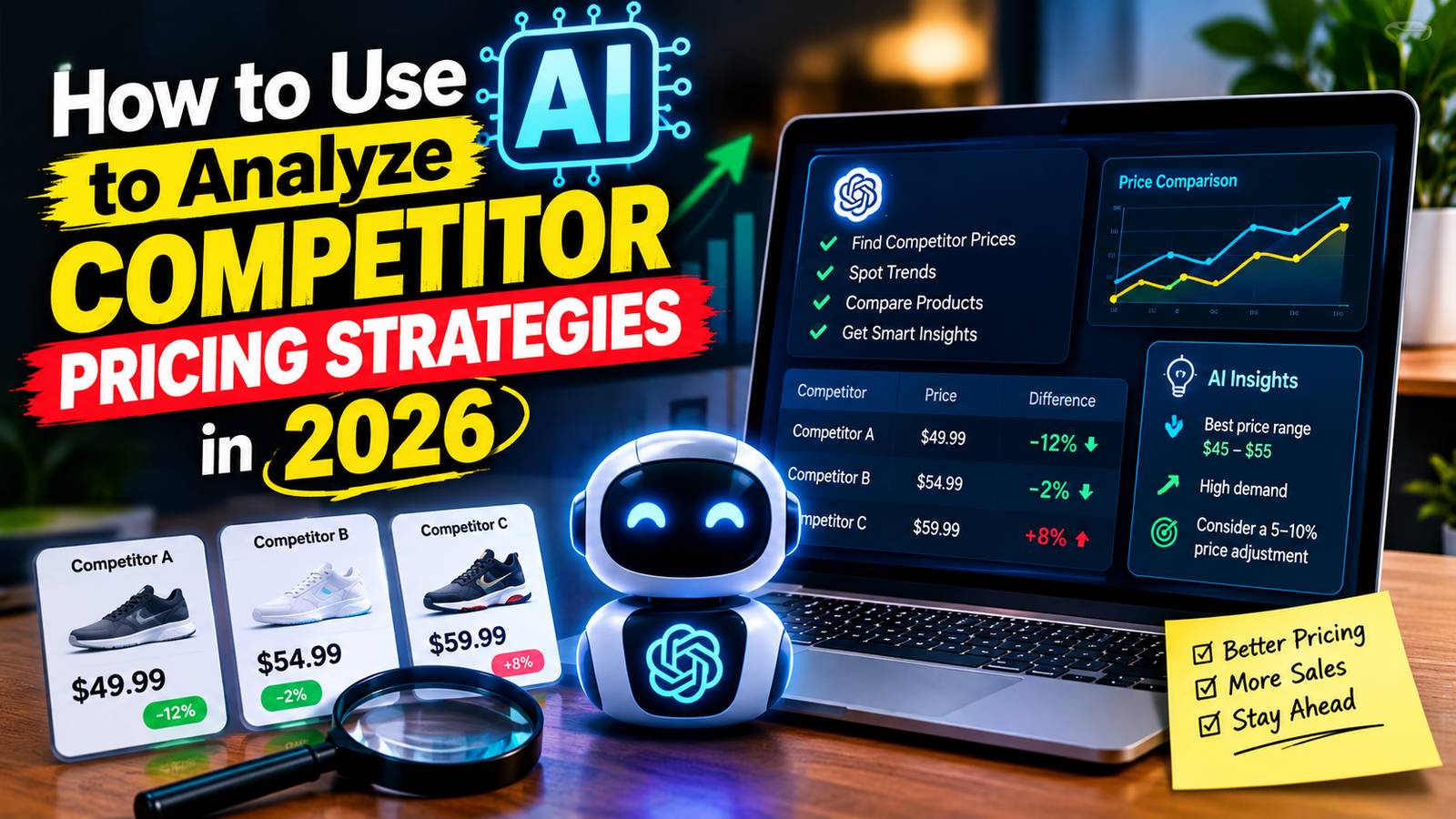
Pricing is one of the most important decisions for any business. Set your prices too high, and some customers may choose another option. Set them too low, and you might struggle to cover your costs or make a reasonable profit.
The difficult part is understanding what customers are willing to pay and how competing businesses price similar products or services.
This is where AI can help.
Instead of manually visiting dozens of websites and writing down every price, you can use AI tools to organize pricing information, compare different plans, identify patterns, and find opportunities to improve your own pricing strategy.
For example, imagine you sell an online service for $19 per month, while three competitors offer similar services for $9, $15, and $29. At first, you might assume that lowering your price is the best solution. However, after comparing their features, usage limits, customer support, and target audiences, you may discover that your product offers something valuable that justifies its price.
That is the real purpose of competitor pricing analysis.
In this guide, you will learn how to use AI to analyze competitor pricing strategies in 2026, which tools can help, and how to turn your research into practical business decisions.
What Is Competitor Pricing Analysis?
Competitor pricing analysis is the process of studying how other businesses price products or services similar to yours.
It involves more than comparing numbers. You also need to understand what customers receive for their money.
For example, two AI writing tools might both offer a $20 monthly subscription.
However, one might include unlimited projects, while the other limits the number of words users can generate. One might offer team collaboration, while the other is designed for individual users.
Although their prices are identical, their overall value is different.
A proper pricing analysis examines several factors:
- Product prices and subscription plans
- Features included in each plan
- Free plans and trial
- periods Usage limits and additional charges
- Discounts and annual billing options
- Target customers and product positioning
- Differences between basic and premium plans
AI can help organize this information and highlight differences that might otherwise be easy to miss.
However, it cannot automatically know every competitor’s current prices. You need reliable, publicly available information to produce useful results.
Why Should Businesses Use AI for Pricing Research?
Traditional pricing research can become time-consuming when several competitors offer multiple products or subscription plans.
You may need to visit different websites, read pricing pages, compare features, and keep track of changing prices.
AI can make this process more manageable.
1. Compare Multiple Pricing Plans
You can collect pricing information from several competitors and ask an AI assistant to organize it into a comparison table.
This makes it easier to identify differences in monthly prices, annual discounts, feature limits, and available plans.
2. Discover Pricing Patterns
AI can help identify patterns in your collected data. For example, you might notice that most competitors offer three subscription levels: a free plan, a standard plan, and a premium plan.
This observation can help you understand how businesses structure their offers.
3. Find Gaps in the Market
Perhaps most competitors focus on expensive plans for large businesses, while only a few offer affordable packages for freelancers.
That could be an opportunity worth investigating.
It does not automatically mean that a cheaper product will succeed. You still need to consider customer demand, costs, and profitability.
4. Save Research Time
AI can summarize long pricing pages, organize product features, and prepare initial comparisons.
You can then spend more time evaluating the results instead of collecting and formatting every detail manually.
Best AI Tools for Analyzing Competitor Pricing Strategies
You do not need every tool on this list. Choose the ones that match your research needs and budget.
1. ChatGPT — Best for Comparing Pricing Information
ChatGPT is useful for analyzing pricing information you provide, including product descriptions, public pricing pages, and spreadsheets.
Suppose you are researching five AI software products. You collect their prices, features, and subscription limits, then provide that information to ChatGPT.
You can ask it to identify the cheapest plan, compare features at similar price points, and explain how the products position themselves.
It can also help you generate questions for further research.
Useful features:
- Organizing pricing information
- Comparing product features
- Summarizing pricing structures
- Creating comparison tables
- Suggesting questions for customer research
Practical example:
If your software costs $15 per month and competitors charge between $10 and $25,
ChatGPT can help compare what each product offers at those prices. It may reveal that your product includes a feature competitors reserve for their premium plans.
That could become an important selling point.
Remember that the quality of the analysis depends on the accuracy of your input. Verify prices and features before making business decisions.
Website: https://chatgpt.com/
2. Google Sheets — Best for Organizing Competitor Prices
Google Sheets is not primarily an AI pricing research platform, but it is a useful place to store and compare the information you collect.
You can create columns for competitor names, monthly prices, annual prices, features, usage limits, and pricing page links.
You can then use spreadsheet formulas, charts, and available AI-assisted features to organize the data and identify patterns.
For example, a spreadsheet can calculate the average monthly price of a group of comparable products. It can also help you compare annual billing against monthly billing.
Useful features:
- Organizing competitor pricing data
- Calculating averages and price differences
- Comparing monthly and annual plans Building pricing comparison charts
- Tracking changes over time
Practical example:
Imagine you collect prices from eight competing tools. Rather than checking each website every time you want to compare prices, you can keep the information in one spreadsheet and update it periodically.
This makes pricing research easier to repeat.
Website: https://sheets.google.com/
3. Visualping — Best for Monitoring Pricing Page Changes
Competitor prices can change over time. A business might introduce a new subscription plan, increase its prices, remove a discount, or change its usage limits.
Visualping helps monitor changes on webpages and can notify users when selected content changes. Available features depend on the current plan.
You can use it to monitor publicly accessible competitor pricing pages, where supported.
For example, if a competing AI tool changes its monthly subscription from $15 to $18, a pagemonitoring alert may help you notice the change without repeatedly visiting the website.
Useful features:
Monitoring selected webpages Receiving change notifications Tracking visible pricing page updates Reducing repetitive manual checks
Practical example:
Choose a few direct
competitors and monitor their pricing pages. When a change is detected, review the page manually to determine whether the monthly price, annual discount, features, or terms actually changed.
Not every page change represents a price change, so alerts should be verified.
Website: https://visualping.io/
4. Browse AI — Best for Collecting Public Website Data
Browse AI provides tools for extracting and monitoring information from supported websites without requiring traditional programming skills.
Depending on website structure, access permissions, and the current service plan, you may be able to collect publicly visible pricing information and export it for analysis.
For instance, you might want to collect the names and advertised prices of several products listed on a public comparison page.
Automating the collection process can reduce repetitive work, particularly when the same information needs to be checked regularly.
Useful features:
- No-code website data extraction
- Collecting structured information
- Monitoring supported pages
- Exporting data for further analysis
Practical example:
Suppose you are comparing several software products with clearly displayed prices. You can investigate whether Browse AI supports those pages and then use the collected information in Google Sheets.
Always verify the extracted data. Website layouts can change, and automated extraction may miss prices hidden behind login screens, regional settings, or interactive controls.
Only collect information you are authorized to access, and respect website terms and applicable privacy rules.
Website: https://www.browse.ai/
5. Semrush — Best for Understanding Competitors' Market Position
Semrush is primarily known for SEO and digital marketing research rather than exact competitor price monitoring.
However, it can help you investigate competing businesses, their search visibility, and the topics or keywords they target.
This information can provide useful context for pricing research.
For example, if a competitor consistently targets searches related to enterprise software, it may be positioning itself toward business customers rather than budget-conscious individuals.
That does not prove its pricing strategy, but it gives you another piece of information to investigate.
Useful features:
- Competitor domain research
- Keyword and SEO analysis
- Market visibility insights
- Identifying competing websites
Practical example:
Combine Semrush research with publicly available pricing pages. Examine whether competitors with similar audiences offer comparable plans and features.
This can help you understand the market segment each business is targeting.
Website: https://www.semrush.com/
Step-by-Step: How to Analyze Competitor Pricing With AI
Now that you know some useful tools, let’s look at a simple workflow you can apply to your own business.
Step 1: Identify Your Main Competitors
Start by listing three to five businesses that sell products or services similar to yours.
If you operate an AI software business, your competitors might include tools that solve the same problem for a similar audience.
Avoid comparing completely different products just because they belong to the same industry.
For example, a basic AI writing assistant may not be directly comparable to an enterprise content platform with team management, analytics, and advanced integrations.
A fair comparison begins with relevant competitors.
Step 2: Collect Their Pricing Information
Visit the official pricing pages of your selected competitors.
Record the following details:
- Product or company name
- Monthly subscription price
- Annual subscription price
- Features included in each plan
- Free plan or trial availability
- Usage restrictions
- Additional fees, if disclosed
- Date you checked the information
It is also useful to record the currency and billing conditions. A displayed monthly price might require payment for an entire year upfront.
Do not assume that every advertised price represents the amount a customer will actually pay.
Step 3: Ask AI to Identify Patterns
Now provide your verified information to ChatGPT or another suitable AI assistant.
Ask it to identify:
The lowest and highest advertised prices Common subscription structures Features frequently included in standard plans Differences between basic and premium plans Possible underserved customer groups Questions that require further investigation
Here is a prompt you can use:
AI pricing analysis prompt
“Act as a market research analyst. Analyze the competitor pricing data provided below. Compare the advertised prices, included features, usage limits, billing conditions, and target customers. Identify common pricing patterns and possible gaps in the market. Explain which products offer similar value at comparable prices. Do not invent missing information or assume that the cheapest product is the best. Clearly label any assumptions and recommend what additional data I should collect.”
This prompt encourages a structured analysis rather than a simple list of prices.
Step 6: Understand Why Competitors Charge Different Prices5
One of the most important parts of pricing research is understanding the reasons behind price differences.
A competitor may charge more because it offers better customer support, advanced features, integrations, stronger security options, or services designed for larger teams.
Another business may offer a lower price because its product is simpler or targets customers with smaller budgets.
These are possible explanations, not facts you should assume without evidence.
Ask AI to compare the features and customer groups you have documented. Then investigate whether the available evidence supports each explanation.
Step 7: Find Opportunities for Your Business
After comparing your competitors, look for a meaningful opportunity.
For example, perhaps the available products are expensive for freelancers, or their basic plans have restrictive usage limits.
You might consider offering a simpler package for beginners, transparent pricing, flexible billing, or a feature that competitors do not provide at the same price.
However, avoid launching a cheaper plan simply because another business charges less.
Calculate your operating costs, payment processing fees, customer support expenses, and expected profit before changing your prices.
Step 7: Monitor Pricing Changes
Competitor research should not be a one-time activity.
Businesses may change prices when they launch features, enter new markets, adjust subscription limits, or respond to customer demand.
Review important competitor pricing pages periodically. For businesses where pricing changes frequently, you may want to monitor them more often.
Tools such as Visualping can help you identify changes, while a spreadsheet can preserve historical information.
This allows you to distinguish a temporary promotion from a lasting change in pricing strategy.
Common Pricing Strategies You May Discover
During your research, you may notice that competitors use different approaches to pricing.
1. Penetration Pricing
A business launches with a relatively low price to attract customers and establish a position in the market.
This can attract price-sensitive buyers, but the business must still ensure that the model can become financially sustainable.
2. Premium Pricing
A business charges a higher price to position its product as a premium offering.
This strategy works only when the product’s value, quality, reputation, or customer experience supports that position.
3. Tiered Pricing
A business offers multiple plans, such as Basic, Pro, and Enterprise.
Each plan provides different features, usage limits, or support levels. This approach allows customers to choose an option suited to their needs.
4. Freemium Pricing
A product offers a free version with limited capabilities and paid plans for additional features or usage.
This model is common in software businesses. The free plan can help people try the product before deciding whether to pay.
5. Usage-Based Pricing
Customers pay according to how much of a service they use.
For example, a software provider might charge based on API requests, processing time, or generated content.
When you identify these approaches among competitors, consider whether the same model makes sense for your customers and business costs.
Final Thoughts
AI has made competitor pricing research more accessible for small businesses, freelancers, bloggers, and software companies.
Tools such as ChatGPT can help analyze collected information, Google Sheets can organize prices and calculate comparisons, Visualping can monitor supported webpages, and
Browse AI can automate certain website data collection tasks. Semrush can add useful context about competitors’ online visibility.
The most effective approach is to combine these tools rather than expecting one AI platform to do everything.
Start with a small group of relevant competitors. Collect accurate pricing information, compare the features included in each plan, and use AI to identify patterns and questions worth investigating.
Most importantly, do not change your prices based only on what competitors charge. Consider your customers’ needs, the value your product provides, and the costs of running your business.
Competitor pricing analysis cannot guarantee higher sales or better profits, but it can help you make more informed decisions and develop a pricing strategy that fits your business.