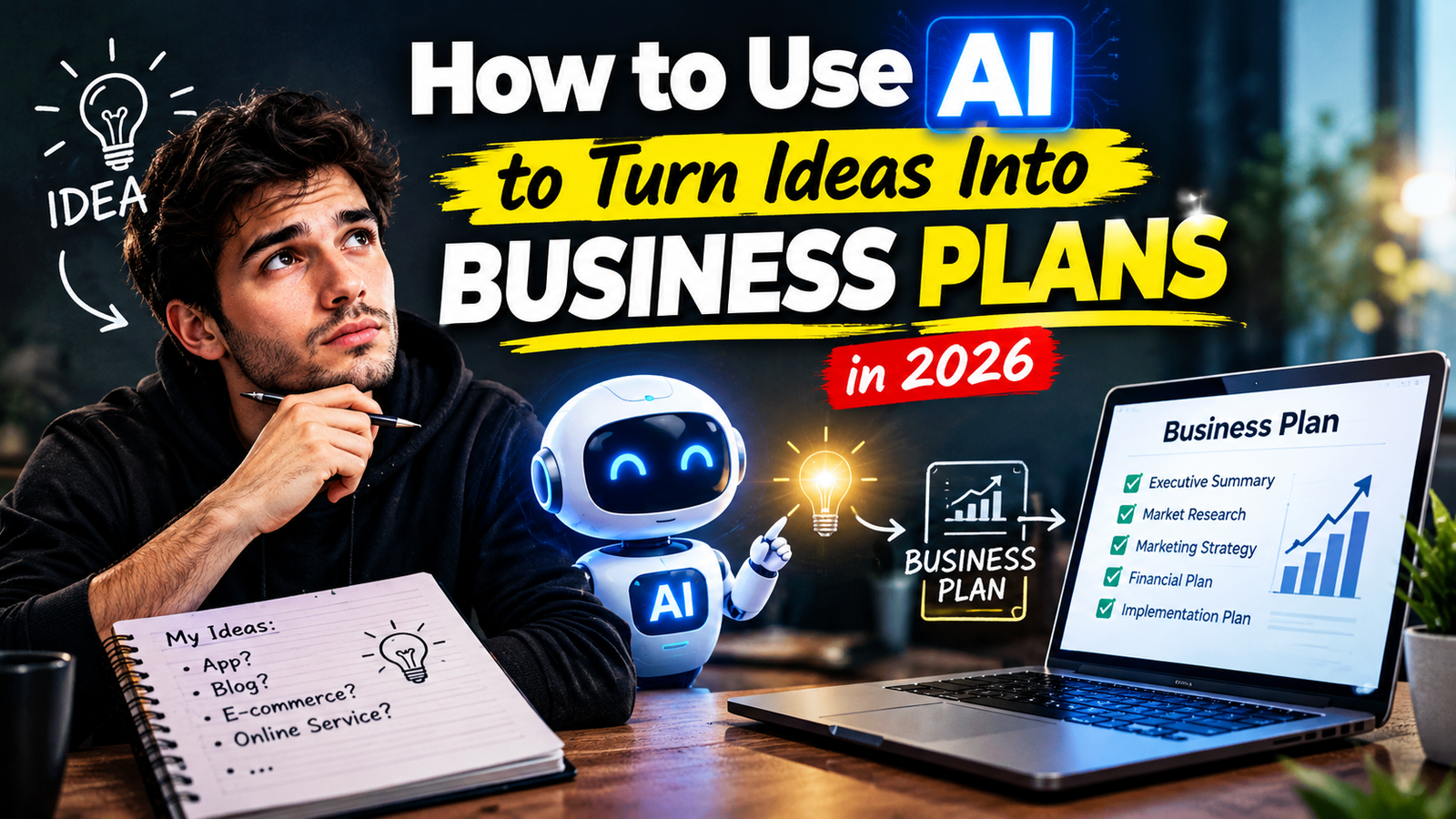
Have you ever had a business idea but did not know how to turn it into a real business? Maybe you want to start an online store, launch a digital product, offer freelance services, or create a small business from home. You may understand what you want to do, but writing a complete business plan can feel confusing.
This is where artificial intelligence (AI) can help.
AI tools can help you organize your thoughts, research your target audience, estimate expenses, study competitors, and create a structured business plan. You do not need to be an experienced entrepreneur to get started. With clear instructions and the right approach, you can use AI to turn a rough idea into a practical plan.
However, AI cannot guarantee that your business will succeed. Its suggestions may contain incorrect information, unrealistic financial estimates, or assumptions that need further research. You should use AI as a planning assistant rather than treating every answer as a fact.
In this guide, you will learn how to use AI to turn a simple idea into a business plan, which tools can help, and how to improve the final result.
What Is a Business Plan?
A business plan is a document that explains what your business will offer, who your customers will be, how you will earn money, and what you need to operate successfully.
A typical business plan includes:
Business idea: What product or service will you provide?
Target audience: Who is most likely to buy from you?
Market research: What do customers need, and who are your competitors? Marketing strategy: How
will people discover your business?
Business model: How will your business generate revenue?
Financial plan: What will it cost to start and operate?
Action plan: What steps should you take to launch?
AI can help you draft each section and organize the information into a professional document.
Step 1: Explain Your Business Idea to AI
The first step is to describe your idea clearly. You do not need to have every detail figured out. Start with the basic concept and ask AI to help you develop it.
For example, imagine you want to start a business selling digital planners, budget templates, or study notes online.
You could tell an AI assistant what you want to sell, who might buy it, how much money you can invest, and whether you plan to work alone.
The more useful information you provide, the more relevant the suggestions are likely to be.
Example prompt:
“Act as a business planning assistant. I want to start a small online business selling digital planners and productivity templates. My target customers are students and young professionals. I have a limited budget and want to start from home. Help me develop this idea, identify possible challenges, and suggest three business models I could consider.”
AI might suggest selling individual templates, offering template bundles, or creating a monthly membership. You can then compare the options and choose the one that best matches your skills and budget.
Do not accept the first idea automatically. Ask follow-up questions and consider whether you can realistically deliver the product.
Step 2: Identify Your Target Customers
A business needs customers who have a reason to buy its product or service. If you try to sell to everyone, your marketing may become too broad.
AI can help you describe your potential audience by considering factors such as their needs, interests, common problems, budget, and buying habits.
For example, if you plan to sell study planners, your audience might include university students who want to manage assignments, exam dates, and daily schedules.
You can then ask AI to identify the problems these customers may experience and suggest ways your product could help.
Example prompt:
“Analyze the potential target audience for a digital study planner. Describe their main problems, what features they might value, possible objections to purchasing, and ways I could test whether they are interested in this product.”
AI can produce useful hypotheses, but it does not automatically know what real customers will buy. Speak with potential customers, conduct surveys, review online discussions, and study relevant products before making major decisions.
Step 3: Research the Market and Competitors
Market research helps you understand whether people are interested in your product and what other businesses already offer.
AI can help you create a research checklist, compare competitor features, organize customer feedback, and identify questions that need further investigation.
For example, if you want to launch an online graphic design service, you could examine other providers’ service packages, delivery times, portfolios, and customer reviews.
You can then ask AI to summarize the differences and suggest ways your business might stand out.
Example prompt:
“Create a competitor research framework for a small online graphic design business. Include service packages, pricing, target customers, delivery times, customer reviews, strengths, weaknesses, and possible opportunities for differentiation.”
Use real websites, current prices, customer feedback, and reliable market information to verify the results. AI may invent competitor details or provide outdated prices, so do not include unverified claims in your final plan.
Step 4: Create Your Business Model
Your business model explains how your business will earn money.
Some businesses sell physical products, while others offer services, subscriptions, digital downloads, or commissions.
Choosing the right model depends on your product, audience, resources, and competition.
AI can help you compare different options.
For example, a person who wants to teach graphic design could offer individual lessons, sell a recorded course, provide downloadable resources, or combine several services.
Ask AI to compare the options based on startup costs, required skills, time commitment, potential advantages, and risks.
Example prompt:
“Compare three business models for selling beginner graphic design education online: live lessons, recorded courses, and downloadable guides. Explain the advantages, disadvantages, likely costs, and practical challenges of each model.”
Remember that potential revenue is not the same as profit. Your business must account for expenses, taxes where applicable, payment processing fees, refunds, and the time needed to serve customers.
Step 5: Build a Marketing Strategy
Even a useful product can struggle if customers do not know it exists. Your business plan should explain how you will attract potential customers and encourage them to buy.
AI can help you develop a marketing strategy that matches your audience and budget.
Depending on the business, possible channels include:
Search engine optimization (SEO) Social media content Email newsletters Helpful blog articles Short-form videos Partnerships and referrals Paid advertising
For example, if you sell digital study planners, you might publish videos showing how students can organize their study schedules. You could also create blog posts about productivity and link readers to your products.
Example prompt:
“Create a 30-day marketing plan for a small digital planner business with a limited budget. Include content ideas for Instagram, short videos, blog topics, a weekly schedule, and simple ways to measure results. Avoid assuming that every post will generate sales.”
Start with a small number of marketing channels instead of trying to use every platform at once. Track which activities bring relevant visitors, enquiries, and sales, then improve your strategy based on the results.
Step 6: Estimate Startup Costs and Revenue
Financial planning is one of the most important parts of a business plan. You need to understand how much money you may require and how your business could cover its expenses.
AI can help you build a budget spreadsheet and identify common expenses, including:
Website hosting and domain registration Software subscriptions Product development Marketing and advertising Packaging and delivery, where relevant Payment processing fees Other operating costs
Suppose you want to launch a small digital product business. Your expenses might include a website, design software, a marketplace fee, and marketing.
Ask AI to create a spreadsheet with estimated startup costs, monthly expenses, sales assumptions, revenue, and profit.
Example prompt:
“Create a simple financial planning template for a digital product business. Include one-time startup costs, monthly operating expenses, product price, estimated monthly sales, gross revenue, fees, and estimated profit. Clearly label assumptions and leave unknown costs for me to fill in.”
Use actual quotes and current prices wherever possible. If you enter unrealistic sales estimates, AI may create a budget that looks impressive but does not reflect reality.
Prepare conservative, moderate, and optimistic scenarios so you can understand what might happen if sales are lower or higher than expected.
Step 7: Write the Complete Business Plan
Once you have gathered information about your idea, customers, market, business model, marketing, and finances, you can ask AI to combine it into a complete document.
A useful business plan should include an executive summary, business description, target market, competitor analysis, products or services, marketing strategy, operations, financial estimates, and potential risks.
Example prompt:
“Using the verified information I provide, write a clear business plan for my small digital product business. Include an executive summary, business objectives, target audience, competitor analysis, pricing strategy, marketing plan, operating requirements, startup budget, financial assumptions, risks, and a 90-day action plan. Do not invent market statistics or financial facts. Mark any missing information that requires research.”
Review the document carefully. Make sure that the sections agree with each other and that the plan reflects your actual budget, abilities, and goals.
A short, realistic plan that you understand is more useful than a long document filled with generic business language.
Best AI Tools for Creating Business Plans
Several AI tools can help with different stages of business planning.
1. ChatGPT
ChatGPT can help brainstorm ideas, organize research questions, compare business models, draft marketing plans, and structure a business plan.
Website: https://chatgpt.com/
2. Claude
Claude can help analyze lengthy notes, organize information, compare alternatives, and draft structured business documents.
Website: https://claude.ai/
3. Google Gemini
Gemini can help brainstorm business ideas, draft plans, and work through research questions. Available features may depend on your account and region.
Website: https://gemini.google.com/
4. Microsoft Excel
Excel is useful for building budgets, calculating expenses, comparing financial scenarios, and tracking business performance. AI-assisted features depend on the version and plan you use.
Website: https://www.microsoft.com/microsoft-365/excel
5. Canva
Canva can help you present your business plan in a professional format using document layouts, presentation templates, and design tools.
Website: https://www.canva.com/
You do not need to pay for every tool. Start with tools you already have access to and invest only when a paid feature solves a real problem.
Common Mistakes to Avoid When Using AI
AI can make business planning easier, but a few mistakes can reduce the value of the final plan.
Trusting every answer: AI can produce incorrect facts, outdated prices, or invented statistics. Verify important information independently.
Ignoring real customers: A business idea may sound good in a document but fail to attract buyers. Test demand before investing heavily.
Using unrealistic financial projections: Do not assume that you will quickly gain thousands of customers. Base estimates on clear assumptions and actual evidence.
Copying a generic plan: A business plan should reflect your specific product, audience, location, budget, and goals.
Spending too much before testing: Start with a manageable version of your product or service, gather feedback, and improve it before committing to major expenses.
Final Thoughts
AI can help turn a rough business idea into a structured business plan without requiring advanced business-writing skills. It can support brainstorming, customer research, competitor analysis, budgeting, marketing, and document preparation.
However, the quality of the final plan depends on the quality of the information you provide and the decisions you make. AI cannot guarantee demand, predict your profits with certainty, or replace real customer feedback.
Start with one idea, use AI to organize your thinking, verify important information, and test your assumptions on a small scale. Then use what you learn to improve your plan.
The goal is not simply to create a professional-looking document. It is to create a practical roadmap that helps you make better business decisions.